The Word "Buildable" Is Doing a Lot of Work in Caledonia County Land Listings
August 20, 2026
August 20, 2026
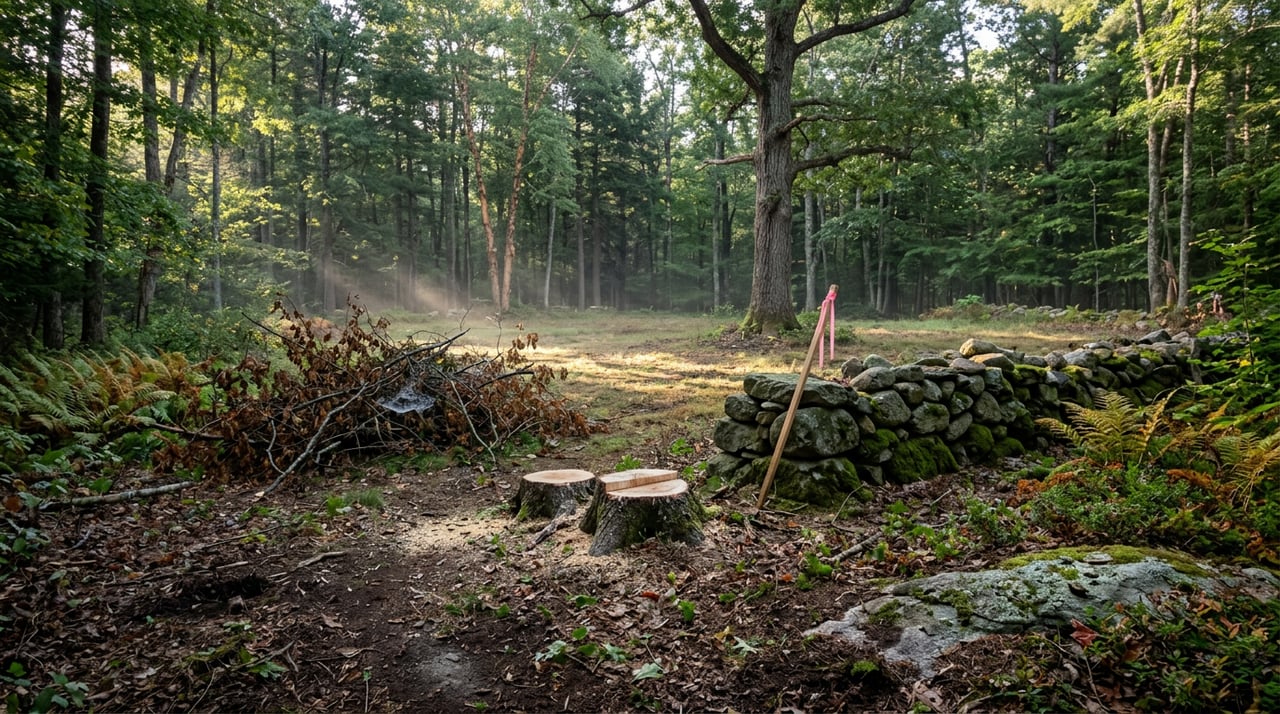
Scroll land listings in Caledonia County this month and you will see the word "buildable" attached to almost everything: a wooded lot on Denio Road in Barnet, a parcel off Quint Road in Ryegate, a hillside tract above the Millers Run in Wheelock. Some of those listings mean it. A recent East Burke listing describes a state engineered and surveyed lot with permits already in place, ready to build. Another, a 58.9-acre wooded parcel outside West Burke with 744 feet of road frontage, says nothing about permits at all. Both are marketed the same way. Only one of them tells you whether the state has actually agreed that a house can go there.
That gap between "the land looks like it could hold a house" and "the state has issued the paperwork that says so" is where Caledonia County land purchases go sideways. It has nothing to do with price per acre, view, or how many miles you are from Burke Mountain Resort. It comes down to a permit most buyers never think to ask about until an attorney or a lender brings it up during due diligence.
In Vermont, the document that governs whether a parcel can support a house is the Wastewater System and Potable Water Supply Permit, issued through the state's Regional Office Program rather than through a town. A licensed designer has to draw up the system, and depending on the size and flow of the property, that could mean a Class BW designer handling a straightforward single-family lot or a Class 1 professional engineer for anything larger or higher-flow.
The state is direct about what happens when this permit is missing or was never obtained for work that needed one. A property can end up with a cloud on title that delays or prevents a future sale, and an owner who built without the correct approval may be forced to pay for a system twice, once to install it and again to bring it up to code. That risk does not disappear when a property changes hands. It attaches to the parcel and travels with it, which is why a raw lot advertised as buildable without any mention of a permit is not automatically a problem, but it is automatically a question you need answered before you write an offer.
If you are buying in Caledonia County right now, there is a recent rule change worth knowing about. Since May 15, 2026, any wastewater system that includes an innovative or alternative pretreatment unit has required applicants to sign an acknowledgment form confirming they understand the ongoing inspection and maintenance obligations that come with that kind of system. The state added this after sending more than 470 letters to Vermont property owners in January 2026 for non-compliance with required inspections, many of whom told the state they had no idea their system even included a pretreatment unit.
That detail matters for anyone buying an existing camp or older rural home in Caledonia County that has been upgraded with an alternative septic system at some point. If the seller has been quietly out of compliance on inspections, you are the one who inherits that obligation the day you close.
Caledonia County covers eighteen towns, from Barnet and Burke down to Waterford and Wheelock, and Act 250, Vermont's land use law, treats them differently depending on local zoning. In towns with what the state calls robust zoning and subdivision bylaws, sometimes referred to as 10-acre municipalities, a commercial project does not trigger Act 250 review until it involves more than 10 acres. In towns without that kind of zoning, the threshold for a commercial project drops to a single acre, and the subdivision trigger changes as well.
If your plan for a Caledonia County parcel is to buy it, hold it, and eventually split off a lot for a family member or a future sale, the town's zoning status is not a footnote. It is the difference between a straightforward local subdivision process and a state-level review with ten separate criteria covering everything from water supply to soil erosion to traffic. Two parcels of identical size in two different Caledonia County towns can face entirely different paths to the same outcome.
A fair number of the larger parcels on the market in Caledonia County right now are enrolled in Vermont's Current Use program, officially the Use Value Appraisal program, which taxes forestland and farmland at its working value instead of its fair market value. One active listing on Denio Road in Barnet, a 100-acre parcel with a selectively harvested stand of oak, carries an annual tax bill of about $350 because of that enrollment. That is the appeal of Current Use, and it is also where a buyer can get caught off guard.
Enrollment requires at least 25 contiguous acres of qualifying forest or farmland, and because Vermont carves out a 2-acre exemption for any homestead on the property, a landowner actually needs at least 27 acres to net the required 25. If you buy enrolled land and later build on part of it, decide to carve out a lot for a second home, or withdraw the parcel from the program altogether, the state assesses a Land Use Change Tax equal to 10 percent of the fair market value of whatever portion gets developed. On a piece of land carrying real market value, that is not a small number.
There is also a paperwork deadline that closings can easily miss. When enrolled land changes hands, the required forms have to reach the Current Use program within 30 days of the transfer being recorded in the town land records. Skip that window and the new owner risks losing the enrollment status entirely, along with the tax rate that made the parcel affordable in the first place.
None of this means Caledonia County land is harder to buy than land anywhere else in Vermont. It means the due diligence looks different than it does for a house in a village with municipal water and sewer. A few questions worth asking before you get attached to a listing:
A permit search through the state's own database, a conversation with a licensed designer, and a quick call to the town clerk about current zoning status will answer most of these before you are under contract. The parcels worth pursuing in Barnet, Burke, Wheelock, Groton, and the rest of Caledonia County are still out there. The ones worth pursuing are the ones where the paperwork holds up as well as the view does.
Does a Wastewater System permit transfer automatically to a new owner at closing? The permit is tied to the parcel and stays on file with the town land records, so a new owner takes on whatever permit status already exists, whether that is a valid permit, no permit at all, or a permit that no longer matches how the property is being used.
What if I want to buy raw land that has never had a permit? That is normal for undeveloped acreage, but it means you will need to work with a licensed designer to get a permit before construction can begin, and the site itself has to pass the required testing to support a system in the first place.
Do I need 25 acres to benefit from Current Use? Yes, for forestland or agricultural enrollment specifically. Smaller parcels do not qualify for this program, though other Vermont property tax relief options exist for owners who do not meet the acreage threshold.
Land in Caledonia County rewards buyers who ask the right questions early, not the ones who move fastest. If you are looking at acreage, a camp lot, or a rural home anywhere from Barnet to Wheelock and want someone who will walk through the permit and tax picture with you before you make an offer, Mykayla Tanguay is happy to help. Let's Connect.
Stay up to date on the latest real estate trends.
If you’re looking for a real estate partner who combines local knowledge, polished marketing, and personal attention, MyKayla offers a full-service experience designed around your goals. She works with luxury buyers and sellers, waterfront property owners, land clients, commercial prospects, and investors who want a resource they can rely on from the first conversation to closing.